It was just another of those months, October 1977, much as July 1977 had been; when there was palpable newness, a month whose every week ushered in yet another development, escorting pop in a different and more adventurous place than it had been. You could feel it – I certainly did – on the radio, in the pages of the music papers; the square had been convinced to turn oblong. It felt so good to experience all of that newness in the present tense, with the future beaming and yet to be written.
Notes on Text
The single of “From Here To Eternity” turned out to have been a best-bits edit of the entirety of side one of the From Here To Eternity album. But I hadn’t heard the album yet – didn’t even know about it (and didn’t properly catch up with it until, ahem, the mid-nineties, when I bought a copy for a really stupid price from upstairs at Notting Hill MVE) – and as splendid as the album’s first side is as a totality – a Los Angeles counterpart to Trans-Europe Express – I still prefer the single edit, which made such an impression on me at an age when impressions count more than at any other age and led me to question just how much – or how little - the pop single could encompass.
My scepticism about “Yes Sir, I Can Boogie” has not changed in the intervening forty-eight years. It just tries too hard to impress, and as Sontag reminded us, trying to be camp automatically makes something not camp.
The main thing I remember about “No More Heroes” from the time was my father asking me if it was the Rolling Stones. Well, it clearly wasn’t…but maybe it should have been.
The only thing I knew in 2000 was Kevin Rowland’s cover of “The Greatest Love Of All” from his unjustly-maligned album My Beauty, a very important record to me at a time when all really did seem lost; it helped to get me out of the long dark tunnel etc. Learning to love oneself turned out to be a full-time job.
The "Latin hut" was one of various annexes of Uddingston Grammar School where we went to classes which weren't held in any of the blocks of the main building. These were basically glorified double-sized Portakabin huts. We got double Latin (two periods, a.k.a. eighty minutes) first thing on a Tuesday after lunch, at one in the afternoon.
How the feck did I know about Cornelius Cardew as a thirteen-year-old, I hear you sceptics query? Because my father knew who he was. Bought The Great Learning, AMMMusic etc. when they were all new. Adored the Portsmouth Sinfonia. Eno name-dropped him in music press interviews. AMM – as they stood in the mid-seventies, which was essentially as two ideological splinter duos – recorded sessions for Radio 3’s Jazz In Britain. In addition my father subscribed to MUSICS, the irregularly regular house magazine of the London Musicians’ Collective. It mostly comprised of a bunch of hairy people arguing loudly with another bunch of hairy people – I recall one particularly hilarious diatribe which contended that acknowledging ethnic music was somehow fascist. I did my best to defuse the sad tension with a number of side-splitting letters sent in under various pseudonyms. The whole thing was republished in book form by an overpraised plantation owner in 2016 (I only just recently found out) but that’s long out of print and currently costs well over a grand second-hand on Amazon. Look, we have a fridge that could do with an upgrade…
I was obviously unaware of the Vietnam subtext that some have attributed to the first Star Wars movie. It didn’t open in Glasgow until February 1978 (at the Odeon in Renfield Street). As I said back then, it was just as well we managed to get into the Loews Astor Plaza cinema on Times Square back in July, and we only had to queue for about twenty minutes (it was an afternoon screening and the day was sunny and hot).
The single of “Heroes” – the additional quotation marks only appeared on the album – underperformed commercially, peaking at #24. It was certainly imposing but not “immediate” in ways that even “Sound And Vision” had been. Matters were not helped by a bandless Bowie having to deal with the lacklustre Top Of The Pops studio orchestra. The talk was that sales of RCA singles at the time (see also Nilsson’s “All I Think About Is You”) were low because all of the label’s pressing plants were fully occupied meeting the enormous demand for Elvis’ back catalogue (he apparently accounted for fully one-quarter of the Top 100 album chart two weeks after his death). However, that does not explain how, on the same label, Baccara were able to get to number one (albeit only for one week) and Meco to number seven.
Contrary to what the single label suggests, “Calling Occupants…” was principally arranged by Peter Knight. The track was recorded in London and, sound-effects and overdubs notwithstanding, essentially done in one live take. The long introduction featuring Tony Peluso as the radio D.J. appears only on the album version.
“Rockin’ All Over The World” peaked at number three for three straight weeks on the British Market Research Bureau chart but made number one on the NME chart, just like “God Save The Queen,” so I sort of got it right.
Some editions of “You’re In My Heart” bear the subtitle “(The Final Acclaim),” but my copy doesn’t.
1 October
GIORGIO: From Here To Eternity/Too Hot To Handle (Oasis OASIS 1)

This is the best and most startling single I’ve heard this year, including “I Feel Love.” Giorgio Moroder strikes out into new pop territory whereas others just talk about doing so. On this single he is rewriting the natural laws of The Pop Song in ways drastic yet liberating. A “Magic Fly” juggernaut of a synthesised bassline, Kraftwerk poignancy in those synthesised strings, drawing in and pulling away like passing train carriages, a song which in itself could have come from 1966 – and, incidentally, sounds as though it’s being sung by Jonathan King – or is it coming back to us from 2026?
Halfway through this song, miraculously, the song disappears, more radically than Donna Summer did after the second chorus of “I Feel Love,” and the overall impression is that of a condensed version of Bowie’s Low – punchy pop songs on side one, pondered nothingness on side two.
It is more than the reverse of “Sound And Vision” since, as I say, both song and singer vanish halfway through the record, like the magician had just waved a magic wand and pop goes up, up, up in a puff of smoke. We are left with nothing but a thumping drum machine – or a magnified heartbeat since we are essentially listening to ourselves.
But then a second bass pulse enters, in the major key as opposed to the opening section’s minor, and a second melody materialises, sung wordlessly by a far-away female voice – perhaps that of Donna Summer herself – and suddenly the new world springs up and blossoms, everything cast in reflective skyscraper glass (or Philip Glass) and we can glimpse a hope and a newness. There is no lead singer but there doesn’t need to be as the music excitedly builds up and echoes back upon itself, its own recent memories, as the piece – we really need no longer call it a “song” – ascends to its climax and the promise of tomorrow flows into the middle distance like the spring of plenty.
“From Here To Eternity” asks the question “What is a pop record?” or changes the question subtly so that it becomes “What can a pop record be?” Here is a solution. The artist disappears, but the world materialises to accommodate both artist and listeners. Above ground rather than subterranean. Sound and vision.
DAVID ESSEX: Cool Out Tonight/Yesterday In L.A. (CBS 5495)

Rather conventional midtempo fare from Essex, whose vocal does not sound remotely convinced that its singer is comfortable. “I’m all right/You’re all right” – but are you really? The half-tempo middle-eight does not reassure us, and neither do the mournful lead and pedal steel guitars.
BACCARA: Yes Sir, I Can Boogie/Cara Mia (RCA Victor PB 5526)

This summer’s big Continental dance smash, apparently; begins unpromisingly with a complete steal from “Don’t Leave Me This Way,” and the self-conscious and rather smug lead vocal navigates a song that isn’t as clever as it thinks it is (“I already told you in the first verse…and in the chorus”). It is going to be unavoidably huge, but remains fundamentally unlovable.
DONNA SUMMER: I Remember Yesterday/Spring Affair (GTO GT 107)

The sudden preponderance of Donna Summer records seems to be due to two competing record labels; “Down Deep Inside” was the real follow-up to “I Feel Love” – unless you count “From Here To Eternity” – but this Dr Buzzard-style nostalgic big band pounder, which sounds rather like the inhabitants of Mars attempting to reproduce the sound of Glenn Miller, will do well with Manhattan Transfer fans.
THE STRANGLERS: No More Heroes/In The Shadows (United Artists UP 36300)
They might not be what purists view as punk, but theirs is turning out to the best run of pop singles this year, give or take the Sex Pistols; from the seized-by-the-back-of-the-neck fuzz bass and organ introductory fanfare to the irresistible main riff and Hugh Cornwell’s growlingly rueful lead vocal – and two extended instrumental breaks (in the middle of a three-and-a-half minute pop single!) – this is simply fantastic pop music. Yes, it sounds a bit like the Doors without the Morrison this-is-the-end soliloquies but this would have been a giant hit in the sixties, let alone the seventies. Brilliantly produced by Martin Rushent. The Stranglers know where pop is going. Follow them.
8 October
ROSE ROYCE: Do Your Dance (Part 1)/Do Your Dance (Part 2) (Whitfield Records K 17006)

Attempting to reproduce the “Car Wash” formula with handclaps and gradual build-up towards the sudden string section. More a groove than a song as such, but it remains pretty funky, and the brass-led key transition midway through is very nicely executed.
GEORGE BENSON: The Greatest Love Of All/MICHAEL MASSER: Ali’s Theme (Arista ARISTA 133)
From the film The Greatest, a biography of Muhammad Ali starring the great man himself. I haven’t seen the film so can’t comment on how well this ballad works within it, but this sounds to me like one of those songs like “Somewhere My Love” or “Born Free” which never become a major hit in the charts but end up being covered by so many people that it ends up more popular than most of the songs which do get into the charts (does that make sense?).
I do think that this song isn’t for people of my age, nor of my parents’ age but somewhere in between, meant for those people who have negotiated a very difficult and often painful path in life and come out the other end changed and better. I don’t see too many of these people in my everyday life. Everybody in Uddingston and Bothwell more or less has life laid out for them. Already some of my classmates are talking about driving lessons and mortgages. Aren’t we supposed to be still too young to be thinking in that way?
Meanwhile, we don’t even have a car or for that matter a nice detached house. We live in a first floor tenement flat above a pub. The unspoken thing at school is that I shouldn’t be there, that I’m spoiling the ambitions of others. I personally would have been happy never to have gone to school but my parents can’t afford to pay for private tutors so I’ve no choice. We have to struggle in ways nobody else I know can comprehend.
So perhaps whatever I end up being in 2000 – if the world hasn’t ended by then - will understand this song better. It is faultlessly put together and performed. You have to “love yourself”; not in an arrogant Hitler way but you have to try to become the person that others might one day love. I don’t know how to do that because nobody’s taught me how to do it. All I get are grown-ups shouting at me and telling me that it’s me who’s the problem, not them. I often get the impression that they’d have preferred it if I’d just died at birth and not become an inconvenience. Girls make a big pretence of fancying me but I know in my bones that they’re kidding on, taking the mickey, having fun at my expense.
It's funny (although I’m not laughing). On the one hand I’m not supposed to have girlfriends because they would distract me from my studies and going to university is much more important (but why? So that I’d get a better-paid job and satisfy my parents?). On the other hand I get the feeling that actually my parents would prefer it if I just went out and mixed with people and in fact go out with somebody. They worry about me and are probably right to do so. Why can’t I be more like normal children of my age? The answer to that is: because I’m not “normal.” I’m unlikely ever to become a faithful son of the parish, to do and say the “correct” things and make the “right” bodily gestures, the way all “normal” human beings do. I’m somehow different from all of that, but don’t know whether that’s in a good or bad way.
I think I am fairly confident in myself; I don’t dislike the person I am, even if I do wish he sometimes had a lot more courage and confidence; hard, though, when both of these things are knocked out of you. I’m never going to be in step with the rest of humanity and will doubtless grow up thinking that it’s the rest of humanity who are out of step with me (the first mark of a madman, some say). Learning to love myself, though? Give me a few more years to figure out how to do that, George.
THE CLASH: Complete Control/The City Of The Dead (CBS 5664)

One does sometimes get the feeling that pop singles need permission to get into the charts. This one sounds like it didn’t bother and just went in anyway.
And the radio doesn’t like it. Oh, no. On Tuesday lunchtime, as we were listening to the transistor radio while queuing up outside the Latin hut, we heard Dave Lee Travis ranting and raving about how much he hated this record. “I think this record is absolute CRAP,” he boomed. “But YOU bought it! YOU put it in at number 28!” he thundered. Having a go at your listeners; that’s the swift route to popularity – although by “YOU” I think he meant those who aren’t SUPPOSED to be listening to his show, and by extension Radio 1. I’ve never heard a disc jockey that angry before, as though his life had just been snatched away from him.
Admittedly “Complete Control” isn’t really like any “pop single” you might have heard before. Even in the sixties, when things like “Have You Seen Your Mother, Baby” and “Strawberry Fields Forever” were thrown down like duel-anticipating gauntlets, they still – just about – hung together and were comprehensible as songs.
But punk really isn’t like anything in the sixties, not even the garage stuff that bore the name of punk rock at the time. “Complete Control” is like an art statement on rock ‘n’ roll. Cornelius Cardew – who incidentally looks quite a lot like Joe Strummer – could have come up with it (if he had a bit more wit).
It starts out as a fairly conventional rocker – oh, it’s that old story about the band and hassles with their record label (CBS put out “Remote Control” from their debut album as an unauthorised second single; it didn’t really get anywhere). But halfway through the record – a moment marked by the dub echoes put in place by co-producer Lee “Scratch” Perry (though recorded in Jamaica, “Complete Control” is not a reggae record as such, excepting the blood and fire) – things change completely; the song begins to deconstruct, dematerialise…words are sung or howled out of tempo or context. It is as if Strummer is testing the boundaries of a rock ‘n’ roll record, seeing how far he can hammer them until they collapse.
At the song’s climax, the singer has been reduced, or magnified, to an intemperate wreck, loudly asking what the point of the Clash, or punk, might be at all – has it all been for nothing, or this (which is as good, or as bad, as “nothing”)? As climactic guitar chords demolish this particular wall of sound, the listener feels that rock ‘n’ roll has been…dynamited. Its wreckage is magnificent, it could stand as the last rock ‘n’ roll song, and Elvis, somewhere deep within him, would surely and instinctively have understood it.
MECO: Star Wars Theme-Cantina Band/Funk (RCA Victor XB 1028)
Whereas this represents a different kind of future. We saw Star Wars when we were in New York in July, and it’s just as well we went there because the film hasn’t come to Glasgow yet. I loved it. It’s daft, preposterous and very funny, and my father says perhaps space-age sci-fi action is what was needed after Vietnam, Watergate and Jaws; people just needed to feel happy again.
Meco Monardo’s done John Williams’ music full service – not as “funky” as Lalo Schifrin’s “Jaws” but unapologetically disco with gurgling synthesiser bleeps and a speeded-up “I Remember Yesterday”-style forties tootle at its centre (American Graffiti in space, my father calls the film, but I haven’t seen it and it’s yet to turn up on television). Great and very hopeful fun.
15 October
NAZARETH: Hot Tracks (E.P.) (Mountain NAZ 001)

Track listing: Love Hurts/This Flight Tonight/Broken Down Angel/Hair Of The Dog
Rather belated UK 45 release of the Dunfermline rockers’ superior Roy Orbison cover that’s already hit big in America – certainly far superior to Jim Capaldi’s terrible disco version, with a tour de force of a vocal performance from Dan McCafferty. The other three tracks are career highlights for newcomers.
DAVID BOWIE: Heroes/V-2 Schneider (RCA Victor PB 1121)

What was he keeping in, everybody asked when Low came out. What was he hiding from? That record concluded with a lonely, awkwardly-pitched saxophone – Bowie’s own – as heard far away, on the other side of a huge wall, in Berlin.
Whereas this song’s primary intent seems to be to demolish that wall.
This year has hardly been short of overwhelming records but this might prove the most overwhelming of the lot, and a stunning response to bored cynics who thought the Bowie of Low was just feeling sorry for himself and the world, in that order. Here he breaks through that self-imposed curtain of introspective exclusion and sings – boldly, he SINGS this song – as though he were Vera Lynn in 1942, in the middle of a war.
Eno is still here but so crucially is Robert Fripp. All the delay tactics they used on No Pussyfooting are put into joyful practice here. It sounds as though Fripp’s guitar is cheering Bowie, egging him on and encouraging him, and the entire band are not just behind their singer, but side by side with him. It sounds so unreal, yet few pop singles have sounded more real.
“Heroes” could rightly be termed an anthem, perhaps Bowie’s most explicit and heartfelt anthem since “Rock ‘N’ Roll Suicide.” Not only are we not alone, but these two – the two lovers of whom Bowie metaphorically sings – could never be closer together. They kiss as the bullets fly over their heads, as though nothing could fall. As though they could outlive the world, if so they chose.
“Heroes” is a song of hard-earned happiness and hope, the greatest tribute to Elvis’ memory anybody could conceive – how fitting that it should appear on the same label – because even though Bowie’s lovers might be caught in a trap, they can actually find their way out, and if needs be fight for the right to do so. It is a song that will be remembered fondly and sung strongly fifty years from now. Whether or not it becomes a big “hit” is beside the point; some songs resonate in ways that seven-day spurts of momentary popularity do not readily reflect. Sung more passionately than Bowie has ever attempted before, “Heroes” is a song for all of us. About what it means to be a human being.
CARPENTERS: Calling Occupants Of Interplanetary Craft (The Recognized Anthem Of World Contact Day)/Can’t Smile Without You (A&M AMS 7318)
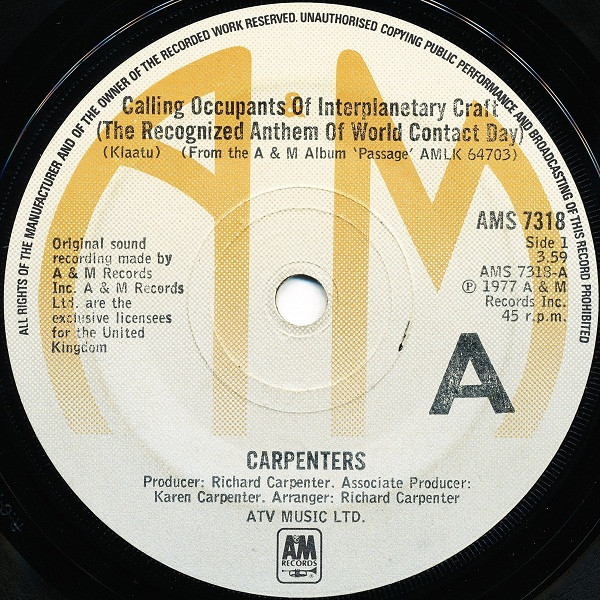
There is a Canadian band called Klaatu who people thought were the Beatles in disguise. Perhaps that was wishful thinking taken to an extreme. However, the Carpenters evidently liked one of their songs enough to attempt a cover, and it is quite unlike anything they have done before, with Karen and a hazy-sounding Richard in a large, dark hollow at midnight, with hundreds if not thousands if not millions (would it be transmitted on live TV?) of other observers to hand, waiting for the aliens to land, open up their ship and reveal themselves. It is epic in a “Music”/”Nights In White Satin” manner with orchestra, choirs and possibly the rest of the human race. It’s almost a flashback to late sixties MoR adventures like “MacArthur Park” when people still retained the capacity to dream (this song might simply be a huge hallucination). More Electric Light Orchestra than Carpenters, I’d say – and arguably more Roy Wood than either – but this should be their biggest hit in quite some while. How do they hope to follow it, though?
STATUS QUO: Rockin’ All Over The World/Ring Of A Change (Vertigo 6059 184)

Their strongest single since “Down Down,” this exuberant cover of a John Fogerty song is in its cheerful way as life-affirming as “Heroes” with its instant singalong choruses and its endless ascents (and even the nice high-pitched organ punctuations and John Coughlan’s subtly insistent drums). A bit of competition at the moment but this sounds like a second number one to me.
ROD STEWART: You’re In My Heart/You Really Got A Nerve (Riva RIVA 11)
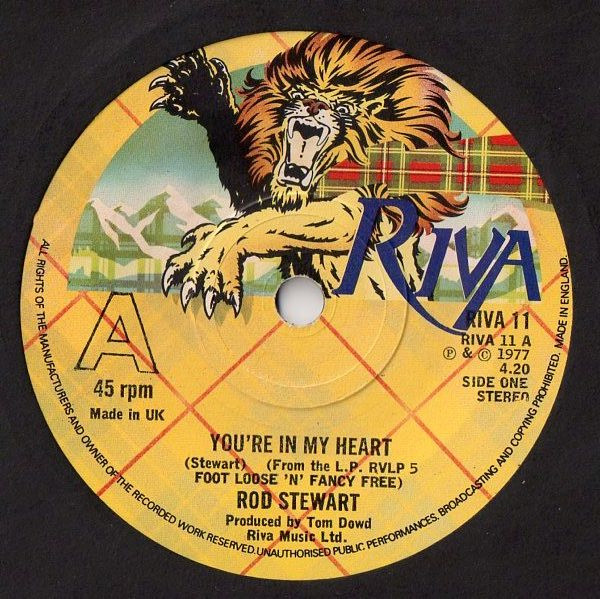
“Ah, proper music!” sighed my father, listening to the acoustic guitar introduction. “Proper guitar playing!” This is an obvious attempt by Rod to get back to his “Maggie May” days, violin flurries and all. I think he’s too rich and too far away and has seen too much to convince me these days, but this is nevertheless a nice, catchy scarf-swayer of a tune.
22 October
QUEEN: We Are The Champions/We Will Rock You (EMI 2708)
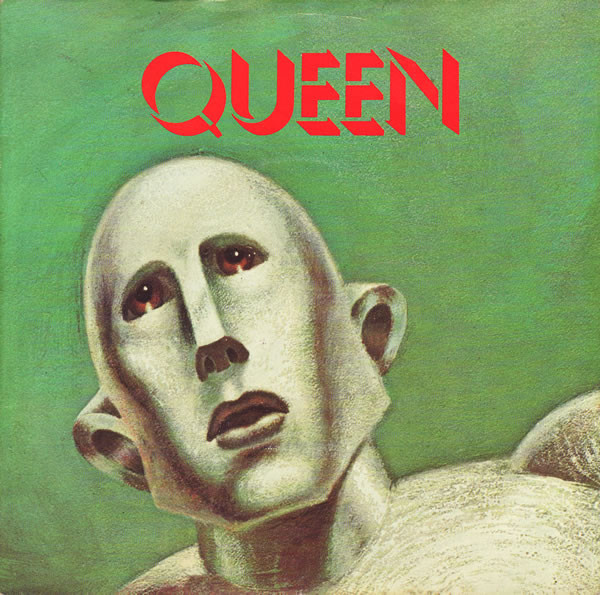
Somebody had to make a song out of that playground/football terrace chant sooner or later, and it might as well be Queen doing it. Big, proud, declamatory and deliciously theatrical, brimming with the self-confidence that his character lacked in “Bohemian Rhapsody” and “Somebody To Love,” Freddie Mercury apologises to nobody for anything and wants you all to know his steadfastness and his buoyant disregard for scansion (“You brought me fame and fortune ANDEVERYTHINGTHATGOESWITHIT!”).
The B-side is extraordinarily minimalist and almost punk-like; glam drum stomp, in tandem I think with a drum machine, as well as chanting vocals and seemingly random jabs of guitar, like the Sweet (remember them?) reduced to their smouldering essence. It’s almost a pity they didn’t go with this for the A-side.
ROXY MUSIC: Virginia Plain/Pyjamarama (Polydor 2001 739)

Sometimes you just have to wait for the right time for pop singles to make complete sense. I wasn’t really following the charts when “Virginia Plain” was first a hit five years ago, but its re-emergence now (to promote a forthcoming greatest hits album on a new label) is strikingly of the moment. Outrageous, unworldly, avant-garde noises mixing with elemental rock ‘n’ roll, like Jake Thackray with Chicory Tip on acid or at least Cointreau, “Virginia Plain” pulls so splendidly together as a pop record that its 1977 punk companions should be flattered by its presence. It sounds so NOW.
MARY MASON: Angel Of The Morning-Any Way That You Want Me/The Stuff That Dreams Are Made Of (Epic EPC 5552)

A curious medley of Chip Taylor songs – they both, unsurprisingly, sound like “Wild Thing” – with a refreshingly experimental orchestral arrangement by Steve Gray, this record is at least nine years out of date and its presence in the 1977 charts is puzzling, if not unwelcome.
SMOKIE: Needles And Pins/No One Could Love You More (RAK 263)
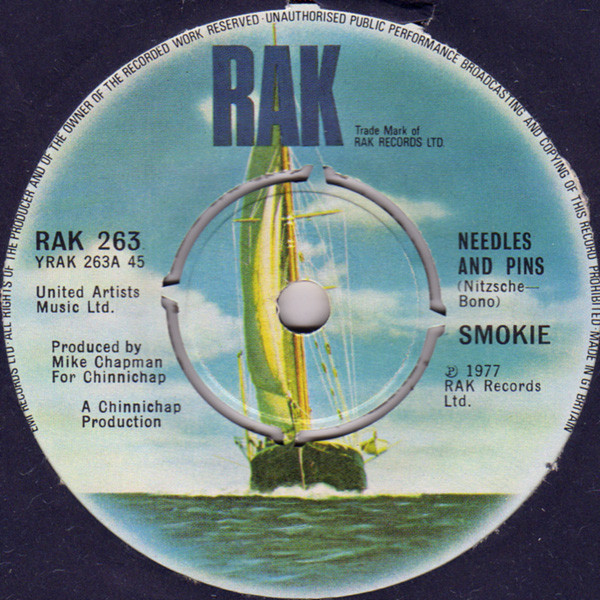
Remember the Searchers? Smokie and RAK Records do. This song went to number one the week I was born. The band give it a good and thorough punk-rock thrashing. No they don’t; I was only kidding. Makes Manuel and his Music of the Mountains sound like the Globe Unity Orchestra.
ABBA: The Name Of The Game/I Wonder (Departure) (Epic EPC 5750)

For those not yet taking Abba seriously, it’s about time that we all did, since this is an expansive and adventurous pop record which falls just short of the five-minute mark without making any fuss about it. No evidence of schlager or campfire singalongs – although there is, in the first half of its chorus, the hint of “Wild Thing” - on this wondrously dextrous winding road of a song which expertly criss-crosses its sometimes conflicting rhythms without ever really arriving at a resolution. Chords and instruments stroll by each other with mild curiosity like disinterested tourists, while the voices are emotionally indistinct and lyrically undecided – at least they remain so until the gradual emotional explosion of the bridge that patiently leads into each chorus, simultaneously mourning and celebratory. This is a rare knack that even the Beatles didn’t touch with undue frequency. And all the song is asking is to be taught…how to love. As modern as anything else in this chart.
SEX PISTOLS: Holidays In The Sun/Satellite (Virgin VS 191)
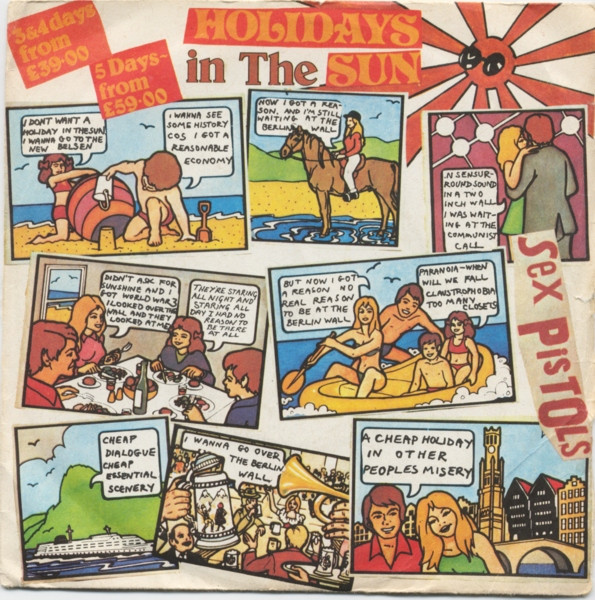
This month really feels like the peak of something. Everyone, be they Abba or the Clash, pulling together to push pop forward. New ideas or new angles on old ideas. Were the sixties as exciting as this? Why bother sticking to the old days when there’s so much demanding our attention today?
I suppose we were all waiting to see what the Sex Pistols had to add, and “Holidays In The Sun” was more than worth the wait. If “Complete Control” depicted the Clash struggling not to self-destruct, then the new Sex Pistols single sounds like the last trump of rock ‘n’ roll before it is obliterated forever.
The song – if it can be called such – begins with jackboots over a guitar drone. Then the jackboots are reinforced with a thumping bass drum – we could almost be listening to Slade – before Steve Jones’ coruscating, more-noise-than-notes guitar helter-skelters downhill to usher in…the riff to “In The City” by the Jam, but magnified a millionfold. “A cheap holiday in other people’s MIZZZRY!” drawls Johnny Rotten before getting into the song, as such, which speaks of “the new Belsen” and “a reasonable economy” before reaching a chorus, the backing vocals to which sound more like “sieg heil” than “reason.” It’s irresistible and terrifying.
Like Bowie, Johnny Rotten wants to escape the myth of the Berlin Wall, but finds the wall itself intractable and unbreakable. He begins to despair, and even before Jones’ fire alarm guitar solo has already begun to break the bounds of rhythm, harmony and melody with his increasingly frantic and desperate musings. When the Jam riff returns for a final lap or eight of honour, the singer has lost control, is rabbiting on about anything that crosses and coarsens his mind. “I DON’T UNDERSTAND THIS…BIT AT A-W-ALL!” like he doesn’t understand anything about music or art, or sees some sort of emptiness and futility – if you will, a pretty vacancy – about anybody’s power to do or change anything, admitting, to himself and to us, that the pop song as conduit for communication is self-defeating and pointless, and that all that remains is…gibberish. By the end he’s long since given up even trying to sing or keep time. The song – or the notion of “The Song” - might as well not exist as far as he’s concerned now. He espies a deadness in our eyes, our minds, our brains, that can never be respected or resolved. He concludes “Please don’t be waiting for me!” (and making it sound like “Police cars be waiting for me!”) before the guitar is abruptly switched off in the manner of a life support machine.
The thirty is no longer fun.
29 October
SANTANA: She’s Not There/Zulu (CBS 5671)

Absent from the singles chart for three years, Carlos and Co. return with this spruced-up Zombies remake with very Jack Bruce-style vocals by Greg Wilson, and Carlos himself on guitar blasting into the next spiritual universe as usual.
DOROTHY MOORE: I Believe You/Love Me (Epic EPC 5573)

Solemn if heartfelt MoR soul ballad from the “Misty Blue” singer.
TOM ROBINSON BAND: 2-4-6-8 Motorway/I Shall Be Released (EMI 2715)

I guess this is EMI’s big bet for New Wave after they dropped the Pistols. Sounds solidly like pub rock to me – you wouldn’t get the Damned covering Dylan for a B-side - but this is a good-natured and very catchy life-on-the-road singalong (for once, touring is celebrated rather than complained about) with superb guitar playing and excellent group dynamics. Mr Robinson’s heart is also clearly in the right place, so good for him. And who else could have come up with that ominous punchline “Nobody knows the motorway’s leading nowhere”?


The pistols single suggested they could go on, getting stronger as they did. We know now this was where it ended. Potentially, "Belsen was a Gas" would have been the next one, but it's not a good song
ReplyDeleteso..